Friday, February 17, 2012

The USDA and Local Food Security


The United States Department of Agriculture announced this week it's support for local food security organizations. Marking a great leap forward in healthy eating in the U.S., these grants show the growing importance of food security in our own country. With a focus on low-income communities and good nutrition, these programs are working to eliminate food deserts all over the country. For numbers and figures check out the press release here:

http://www.usda.gov/wps/portal/usda/usdahome?contentid=2012/02/0052.xml&contentidonly=true

-Dana Lofgren

Food Security and Genetic Engineering: The Effect on the Growing Communities

Genetically Modified Foods: Harmful or Helpful?

The debate about Genetically Modified Foods/Organisms (or GMO's) becomes a question regarding the effects that these products have on the body, surrounding plant habitat, and environmental effects.

Background

“The term GM foods or GMO's (genetically-modified organisms) is most commonly used to refer to crop plants created for human or animal consumption using the latest molecular biology techniques. These plants have been modified in the laboratory to enhance desired traits such as increased resistance to herbicides or improved nutritional content. The enhancement of desired traits has traditionally been undertaken through breeding, but conventional plant breeding methods can be very time consuming and are often not very accurate. Genetic engineering, on the other hand, can create plants with the exact desired trait very rapidly and with great accuracy.… Not only can genes be transferred from one plant to another, but genes from non-plant organisms also can be used.”
 

According to the USDA and FDA there are over 40 plant varieties that have completed all federal requirements for commercialization. These include

GM Foods
·         Tomatoes
·         Cantaloupes
·         Soybeans
·         Sugar beets
·         Corn
·         Cotton plants

Specifically the soybean, used as a staple food additive in the United States, ensures that most US consumers have been exposed to GMO’s.  Of all GM crops, the US grows 68% with soybeans and corn as the top two foods grown.

While GMO’s do have increased tolerance and resistance to the variable that usually would worry the farming community, can have special nutritional value added to them, and can improve their pharmaceutical use, there are many negative aspects.

The GMO industry is criticized for “pursing profit without the concern for potential hazards and the government for failing to exercise adequate regulatory oversight.” The industry is facing doubt majorly concerning environmental hazards, human health risk and economic concern. GMO’s can cause unintended harm to other organism, reduce the effectiveness of pesticides causing increased dosages to be used, cause gene transfer to non-target species, and allergies. The effects on human health are mostly unknown but the potential for a large risk to human health is great.

In 1999 FDA held there meetings with the US public to begin the process of establishing a new regulatory procedure for government approval of GMO's. While some countries (Brazil) have banned GM crops, in the US, a more (lenient) regulatory system is in place.

In the United States, the regulatory process is confused because there are three different government agencies that have jurisdiction over GM foods. To put it very simply, the EPA evaluates GM plants for environmental safety, the USDA evaluates whether the plant is safe to grow, and the FDA evaluates whether the plant is safe to eat…The FDA counters that the agency currently does not have the time, money, or resources to carry out exhaustive health and safety studies of every proposed GM food product. Moreover, the FDA policy as it exists today does not allow for this type of intervention. “

It is the labeling of GMO’s that is the easiest to make people aware of what they are putting into their bodies. But with that comes the question of the level of detectability of GM food cross-contamination.  A 1% threshold may already be below current levels of detectability.

We must be wary about jumping ahead in science and releasing products without the backing about the risk that they may cause. As now organic produce is extremely important and popular to prevent ingestion of chemicals, avoiding GM crops will most likely be in our near future.

-Marshelle

Tuesday, February 14, 2012

Monday, February 13, 2012

Is Our Lack of Biodiversity Causing Food Insecurity?

Imagine you are trying to refurbish a 1967 corvette, as you are working on the engine, you only have multiple batteries, alternators, and radiators. You cannot exactly make that corvette drive with only those parts. Similarly, we are trying to feed the world with only a few resources. The FAO (Food and Agriculture Organization for the UN) said that "3/4 of the the genetic diversity in agricultural crops has been lost just in the last century! Of 6,300 animal breeds. 1350 are endangered or extinct. Just twelve crops and fourteen animal species feed the world today." Do you think this has caused food prices to rise? I think so! Also, the surge to continue the mass-production of these few resources has forced the other ones to disappear. We cut down biologically diverse forests and replant with a few tree species. This has caused a change in the diet of animals. The same thing has happened to humans. We have removed the biodiversity of food of the world causing a change in diet to all people. We now eat genetically-modified versions of the same product. Just look at how many things contain the ingredient, corn. A list of some corn products can be found here: http://www.livecornfree.com/2010/04/ingredients-derived-from-corn-what-to.html
But what if we, stewards of the earth, strove for biodiversity?
Biodiversity is so important to not only food production and diet but also environmental conservation. We cannot continue exploit nature to give us the few varieties of resources that we want and can modify. This has caused an unequal distribution of resources. 
What if we had small scale polycultural systems of farming? This not only is a traditional form of farming, but it also allows numerous plant species to grow. This in turn causes diversity in the animal kingdom. 
Biodiversity might cause that corvette to start running.

-MAU

Saturday, February 11, 2012

Friday, February 10, 2012

AGRA: Alliance for a Green Revolution in Africa


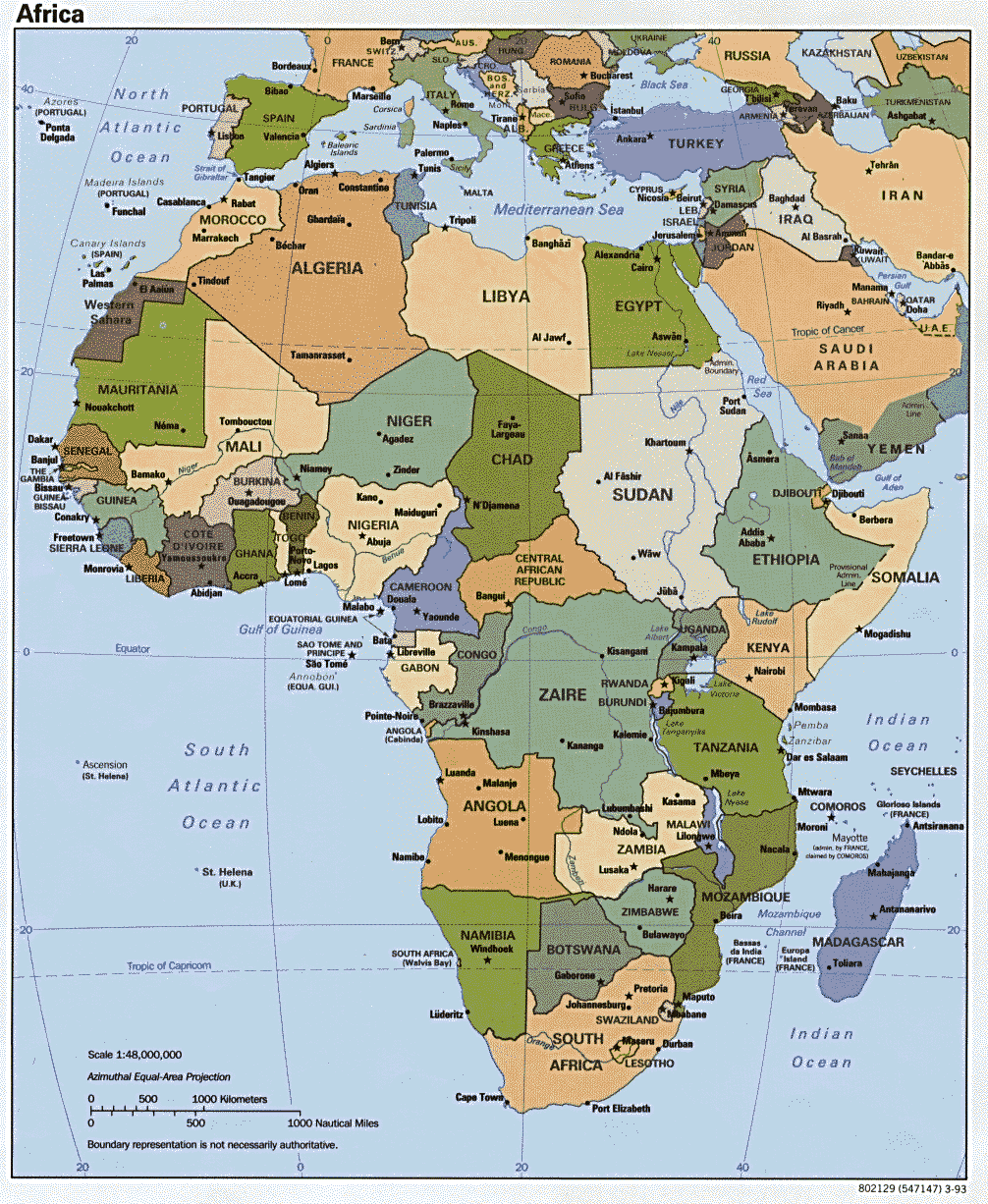
AGRA is an ambitious program led by former UN Secretary-General Kofi A. Annan to eliminate problems of food security throughout the African continent. It's goal is to help countries in Africa create sustainable farming practices that help communities produce their own food. By focusing on all aspects of food production such as the necessary seeds, soil, marketing, finance, and policy, AGRA's comprehensive programs also initiate job growth.

While this may be an example of a top-down approach to change (the Rockefeller Foundation and the Bill & Melinda Gates Foundation are its founders) it is African led and practiced. By giving the financial and research support necessary for such an endeavor, but leaving the decision-making to the various countries and farming communities in Africa, I think that this is the beginning of a respectful approach to a solution.   I believe that this is an example of modern technology and traditional place-based knowledge coming together to forge new ideas. It fosters an atmosphere of mutual recognition and doesn't place the importance of one over the other.

Visit the website for more information, news updates, job or fellowship applications, and stories from the people themselves!

http://www.agra-alliance.org/

-Dana Lofgren

Wednesday, February 8, 2012

Food & Freedom Riders

Tipping their hats to the Freedom Rides of the Civil Rights Movement, a group of inspired young leaders who call themselves the Food & Freedom Riders carried forward the struggle for justice, in the summer of 2011. Their task was to uncover the stories of farmers, workers, and communities who are working to change the food system that denies them justice. Their goal is to weave together a movement of people from diverse backgrounds, and to learn from the past and find the food movement’s own place in history.
What a great way to spread the word! I feel that it is very important to educate young people of the fact that food justice is interrelated with environmental justice and social justice. The food justice battle will not be solved by only focusing on ramping up farmers markets and promoting consumption of locally produced organic food. To address food injustice, it seems that we have to attack poverty. Good food is expensive, thus ramping up our economy seems like a better way to go.
If a group of people in America were denied or had a limited access to education, or health care, this type of problem, I feel, would receive much media and government attention. Why is this not the same for food justice? I never knew of such a thing until I purposely made an effort to learn about it.
The Food & Freedom Riders are working to expose the term food justice, for all to be aware of. If you would like to follow their journey, they can be found on twitter @liverealnoworg.

~MERON A